




Brazil, Coffee, and Sustainability in a New Normal
At KAFFA, we have traveled for over 20 years to find the best farmers and the best beans. Over these years, we have built relationships with some of the most skilled coffee producers in the world through repeated visits to all the places and people we buy coffee from. Building long-lasting relationships and rewarding quality in this way has been among the cornerstones of how we want to work with sustainable coffee trade. Producing truly good coffee requires a lot of careful work. If the challenges were already great, climate change presents an increasingly demanding daily life for coffee producers worldwide. Agriculture that may have yielded good and stable harvests for the past 50-60 years now faces drought, unexpected frost, or water scarcity. The coffee farmer of the future must juggle many thoughts at once. The soil they cultivate can no longer be considered an inexhaustible resource; it can be depleted of nutrients. We believe that coffee farmers who focus on sustainable agricultural principles to preserve the land for future generations will also be those who produce the very best coffee in the future. It is from this perspective that we are now thinking; here are buyer John Ivar's observations from Brazil:

It was wonderful to travel again. Or, the travel part itself was, as usual, quite dull. Two canceled flights, a lot of waiting, etc. But finally being able to go back to the places and people who produce our coffee was great, and something we've missed since the pandemic.
The first few days in Brazil we spent meeting new producers, farmers, and coffee exporters. Everyone was working with either organic coffee or is transitioning to/already working with regenerative agricultural methods.

In short, regenerative agriculture comprises principles for how you care for your soil and plants by creating more plant diversity on the farm (as a kind of counter-reaction to the monoculture coffee farms often are).
Regenerative agriculture improves soil health and fertility because it also consumes carbon from the atmosphere through photosynthesis. It strengthens the microlife in the soil and enhances the water cycle.
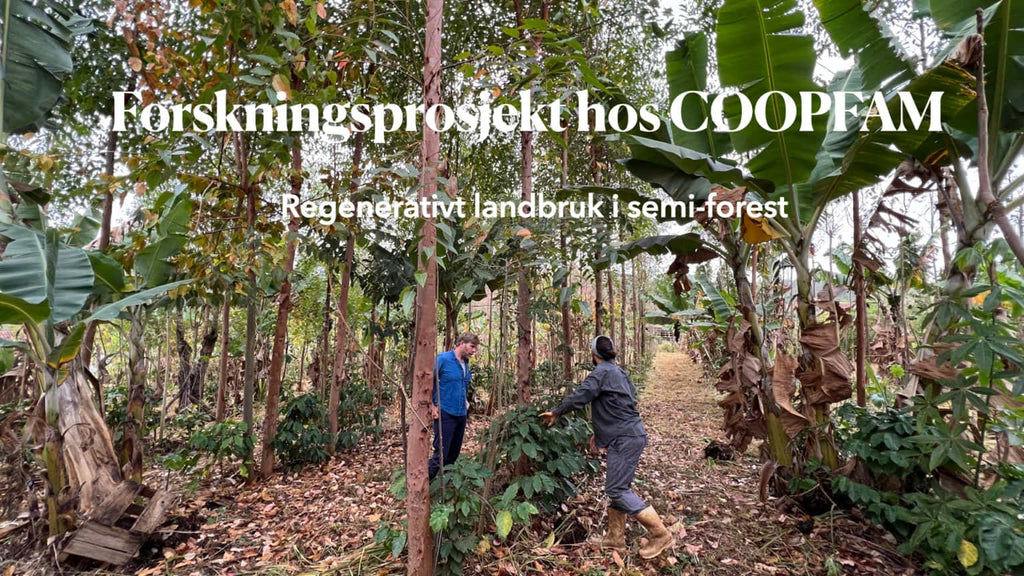

Leonardo, one of the farmers supplying coffee to Coopfam, has renovated his father's farm and is researching regenerative agriculture.
They want to show the other farmers in the cooperative that it is possible to care for the land and the growing conditions of coffee trees in a completely different way than the conventional methods they are currently using.
We were fortunate to be introduced to many of the smartest and most innovative coffee farmers working with regenerative agriculture on coffee farms in Brazil, and were shown around their farms as they talked about and demonstrated their methods.
KAFFA will certainly be collaborating with several of these farmers in the years to come. They represent the future of coffee production; they are pioneers and lead from the front in their field. We will be talking more about this in the years to come!

We spent the next few days visiting our good friends and partners from Carmo Coffees.
Carmo Coffees was founded as an export company by cousins Luis Paulo Pereira and Jaques Caneiro. Carmo Coffees represented the family's 7-8 farms to showcase Brazilian coffee as more than just a commercial coffee producer, but also as a specialty coffee producer with top-notch coffee. Now they sell both their own produced coffee and also have a giant warehouse where they store, mill, and sell coffee from several other farms (Sao Joaquim and Pinheirinho are examples) from and around the Carmo area in the Minas Gerais region.
 At Carmo Coffees, we cupped and selected next year's coffee for the Kaffa menu from well-known coffee farms such as Santa Ines, Santa Lucia, Satiaro Sul, Capim Seco, Irmas Pereira, and Fazenda IP, as well as a batch of anaerobic berry-dried coffee from a brand new relationship, Santa Catarina.

Climatic conditions in Brazil have been tough in recent years. And conditions remain difficult for coffee.
It started last year when many of Brazil's largest coffee regions suddenly experienced a few nights of frost. Coffee trees are vulnerable, and this frost claimed as much as 70% of the coffee trees in the worst-affected areas. We visited several farmers who showed us the devastation on their lands.
To save the trees, they had to prune them down to the trunk to allow them to regrow. It takes three years to get a new, full harvest after that. Some farms and regions were more affected by the frost than others.
But this was just the beginning. Brazil has also been hit by extreme drought both last year and this year. During our stay, the Minas Gerais region finally saw rain for the first time in over 100 days. The fields were dry, and the trees were brown. Farmers who should have produced 150-200 bags of coffee reported that they might only have 10-20 bags this year. Tough conditions.
Some of the exporters we met told us that they had a maximum of 50% coffee to offer this year compared to previous years. And this will continue until the trees affected by frost and drought have grown back.
Not everything is bleak. And the quality was, as usual, tremendously good where they had coffee to offer. But the times and the coffee world are changing, and only the farms and farmers who look to newer scientific methods for agriculture and coffee production will come out on top and stronger in the future. I am quite sure of that.
- John Ivar


Relevante Artikler
-

5 Coffee Myths You Need to Stop Believing
Coffee is a science, an art form, and for many of us, an indispensable part of daily life. As one of Norway's leading...
-
Cupping for Beginners, a Short Guide
Cupping for Beginners: Join the Global Decaf Tasting! James Hoffman invites you to a global online cupping of The De...
-
A Taste of Luxury: Geisha Coffee - an Exclusive Experience for Connoisseurs
Geisha Coffee: A Rare Treasure from Ethiopia's Highlands via Panama's Peaks In the world of coffee, few varieties can...


